

Background
In Part 1 and Part 2 of this series, we examined how Canada’s Life Insurance Capital Adequacy Test (LICAT) treats insurance liabilities measured under IFRS 17, specifically the Contractual Service Margin (CSM) and the Premium Allocation Approach (PAA).
This article turns to the asset side of the balance sheet, specifically debt investments.
Parts 1 and 2 mentioned that IRDAI is considering use of a common balance sheet for Ind AS financial reporting and solvency assessment. IRDAI has now constituted working groups of life and non-life insurers to develop an RBC framework converged with Indian Accounting Standards (Ind AS).1
Debt valuation under Ind AS 109
Debt instruments such as corporate bonds and government bonds form a major component of Indian insurance companies’ assets.
Ind AS 109 (equivalent to IFRS 9) prescribes three measurement models for debt instruments:
- Amortised Cost (AC): Measured at initial value, subsequently adjusted for principal repayments, interest calculated using the effective interest method, and expected credit losses.
- Fair Value through Other Comprehensive Income (FVOCI): Measured at fair value, with changes in fair value generally recognised in OCI (Other Comprehensive Income) instead of P&L (Profit & Loss).
- Fair Value through Profit or Loss (FVTPL): Measured at fair value, with changes in fair value recognised in profit or loss.
The choice is based on the instruments’ cash-flow characteristics and the business model under which the assets are managed. The following flowchart summarises asset valuation model selection under Ind AS 109:
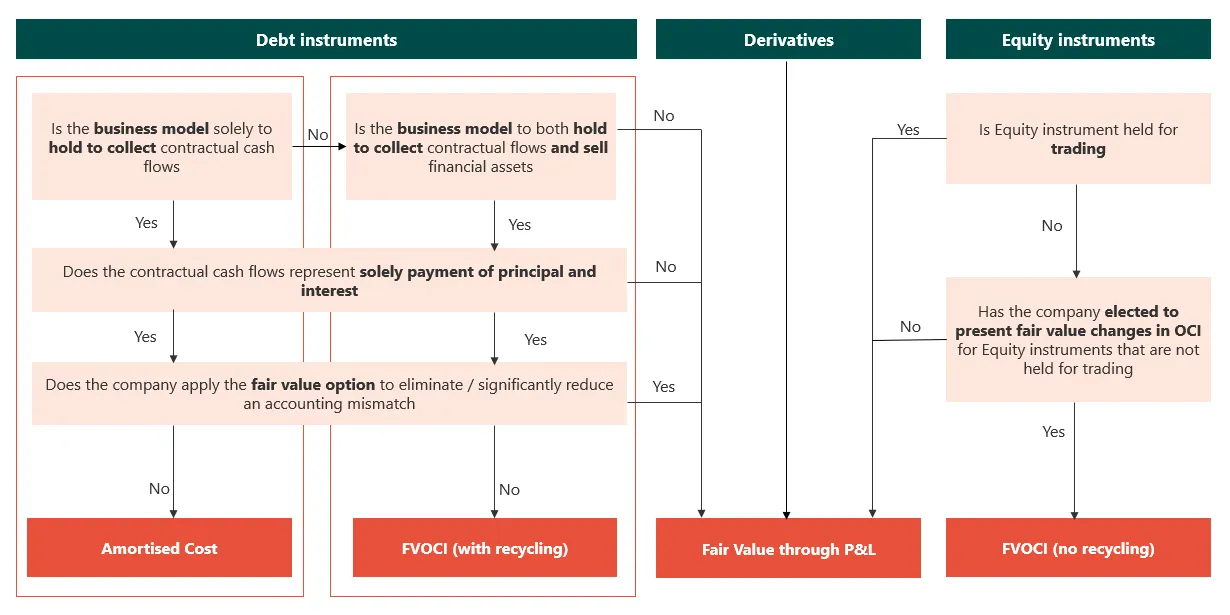
On an Ind AS balance sheet, an asset may be carried at a very different value depending on whether it’s measured under a fair value (FV) approach i.e. FVTPL / FVOCI or under AC.
How LICAT treats debt instruments
LICAT uses IFRS financial statements as its starting point, with specific regulatory adjustments.2 Its treatment of debt investments varies between available capital and the individual risk charges.
| Component | LICAT treatment | Implications of AC vs FV |
|---|---|---|
| Available capital | Based on IFRS carrying amounts, subject to regulatory adjustments. | AC and FV may produce different available capital for identical bonds. |
| Interest rate risk | Asset and liability cash flows are discounted under four prescribed interest rate scenarios. The charge reflects the adverse change in the net position.3 | No difference for identical bonds. The calculation uses projected cash flows rather than accounting carrying amounts. |
| Credit risk | Rating- and maturity-based factors applied to carrying amounts, gross of Stage 1 and 2 ECL provisions.4 | Potentially different charges for identical bonds depending on the measurement model. |
| Currency risk | Factor applied to the aggregate net long and net short foreign-currency positions, subject to prescribed adjustments and offsets.5 | Potentially different charges for identical bonds depending on the measurement model. Accounting carrying values will flow into the net position for foreign-currency bonds. |
Implications for India
India’s most recent RBC Quantitative Impact Study, QIS 2, required assets to be valued generally at fair value, using Ind AS 113 (equivalent to IFRS 13) where appropriate.6 The final framework could retain this approach or move closer to Ind AS accounting valuations.
There are two principal options.
| Approach | Pros | Cons |
|---|---|---|
| Value all debt investments at fair value | Ensures consistent asset valuations across insurers, regardless of their Ind AS 109 classifications. | Requires insurers with AC portfolios to maintain separate fair-value measurements and reconcile them with accounting balances at every quarterly close. This adds work and partly defeats the objective of Ind AS–RBC convergence. |
| Retain Ind AS carrying values (LICAT approach) | Aligns solvency valuations with financial reporting, avoiding separate valuations and simplifying quarterly reporting. | Economically similar investments may produce different solvency outcomes depending on their accounting classification. LICAT’s capital charges do not necessarily eliminate these differences. |
Given the objective of aligning RBC with Ind AS, retaining accounting carrying values would appear preferable. However, the resulting differences in solvency outcomes between insurers holding similar investments would need to be considered carefully. LICAT provides a precedent for accepting these differences in exchange for closer alignment with financial reporting.
Footnotes
-
IRDAI, Office Order — Constitution of Working Groups on Convergence of the Risk Based Capital (RBC) Framework with the Indian Accounting Standards (IndAS), 10 November 2026. The English version follows the Hindi version. ↩
-
OSFI, LICAT Guideline (2025), Chapter 1, section 1.3. ↩
-
OSFI, LICAT Guideline (2025), Chapter 5, section 5.1. ↩
-
OSFI, LICAT Guideline (2025), Chapter 3, section 3.1 and footnote 1. ↩
-
OSFI, LICAT Guideline (2025), Chapter 5, section 5.6. Chapter 1, section 1.3, specifies that LICAT calculations use amounts reported in, or used to prepare, financial statements under Canadian GAAP unless otherwise indicated. For insurance companies, Canadian GAAP is IFRS. ↩
-
IRDAI, Indian Risk Based Capital Framework — Quantitative Impact Study 2: Technical Guidance, August 2025, sections 2.1.4 and 4.1.1–4.1.7. Specific valuation methods and exceptions apply to certain assets. ↩
In this article